

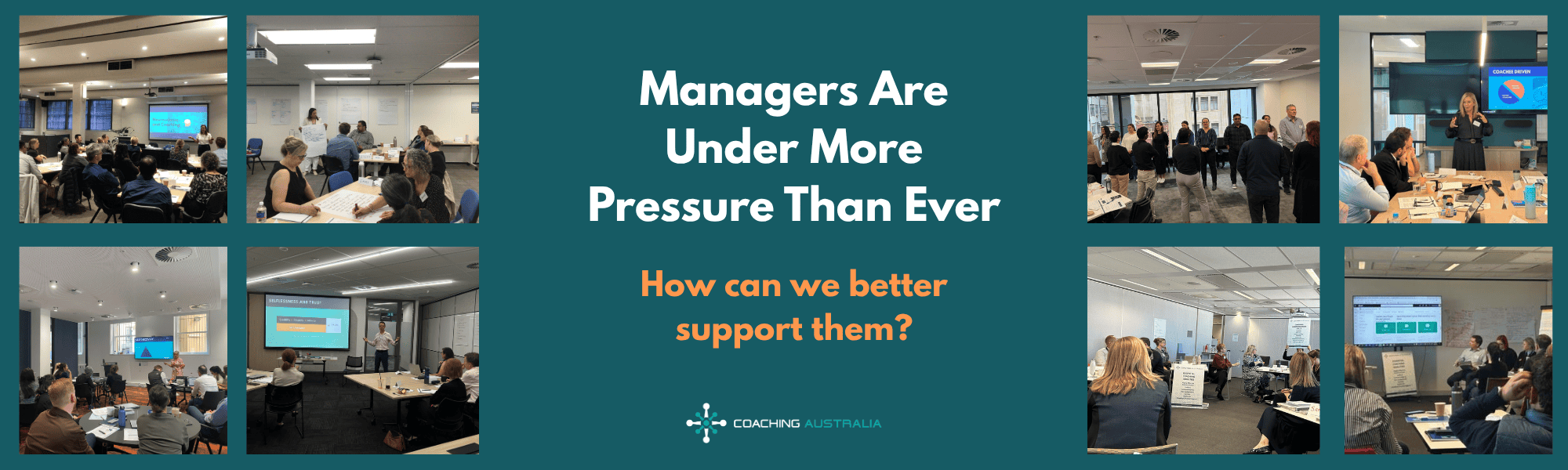
Over the past few months, through conversations with clients and our research, one theme has come through time and time again:
Managers have never been under more pressure.
They are expected to drive performance, lead change, support wellbeing, engage teams, navigate uncertainty and increasingly help people adapt to new ways of working and technologies, all while navigating these challenges themselves.
In many organisations, all roads seem to lead to the manager.
As organisations look for ways to better support managers through increasing pressure and complexity, many are exploring approaches that not only strengthen leadership capability, but also create more sustainable ways of leading. One answer lies in building a coaching culture.
What a Coaching Culture Really Means
A coaching culture is one where coaching becomes part of everyday leadership. Rather than being limited to formal coaching conversations, managers use coaching skills in their day to day interactions to develop others, encourage thinking, build capability and create greater ownership across their teams. Over time, these conversations become part of how people lead, learn and work together.
Formal coaching certainly has an important role to play. Many organisations invest in developing internal coaches who provide valuable support to individuals and teams. A coaching culture builds on this by weaving coaching into day to day leadership, so coaching becomes part of how leaders lead, not just something that happens in formal coaching sessions.
Research from the International Coaching Federation (ICF) also shows that organisations with strong coaching cultures experience higher engagement, stronger team performance and improved productivity. Importantly, coaching cultures help create greater ownership, continuous learning and individual growth.
In practice, it is often the small shifts in everyday leadership that have the greatest impact.
- A manager asks a question instead of providing the answer.
- A team member is encouraged to think through a challenge rather than being told what to do.
- A conversation that creates ownership, reflection and learning.
These moments may seem small, but over time they build capability, strengthen ownership and shape how people lead, learn and work together.
When coaching becomes part of how managers lead, it moves from being something people do to being what leadership looks like.
Why This Matters More Than Ever
Many of the organisations we work with are facing similar challenges.
- They are being asked to do more with less.
- Change is constant.
- Resources are stretched.
- Expectations continue to rise.
In this environment, managers can easily fall into the trap of becoming the problem solver for everyone around them because it is often the quickest option.
While well intentioned, this approach can create dependency, increase leadership load and limit the growth of others.
A coaching approach shifts this dynamic.
Instead of feeling responsible for having every answer, managers learn how to facilitate thinking, build capability and create greater ownership within their teams.
Importantly, it also gives managers a practical way to navigate the challenges they face themselves. By having a space for reflection and thinking, managers often feel more supported and better equipped to lead through complexity.
The result is not only stronger employees. It is more sustainable leadership.
The Evidence Is Compelling
Research consistently shows that coaching is one of the most important behaviours of effective leaders. Google’s well-known Project Oxygen, a multi-year study analysing what differentiates high-performing managers, identified coaching as one of the key behaviours of successful leaders.
Gallup research has also found that equipping managers effective coaching techniques can improve performance by between 20% and 28%, highlighting the impact coaching can have on both individual and team outcomes.
We see similar outcomes in the organisations we partner with.
At HCF, leaders and their teams who participated in our Coaching as a Leadership Style programme demonstrated a 19% uplift in engagement compared to those who had not participated. Participants also reported increased confidence in applying a coaching approach and greater effectiveness in leading their teams.
What is particularly interesting is that these outcomes were not driven by formal coaching alone, but by consistently applying coaching behaviours in their day to day interactions. Over time, these conversations create a ripple effect across teams and the broader organisation.
Supporting Managers, Not Just Developing Them
Leadership development remains important. Increasingly, organisations are looking for ways to better support managers through growing complexity.
A coaching culture provides a practical way to do this by helping managers build capability, ownership and accountability across their teams.
The organisations that will thrive won’t simply ask more of their managers. They will invest in helping them lead differently.
If you’d like to explore what building a coaching culture could look like in your organisation, we’d love to have a conversation.